
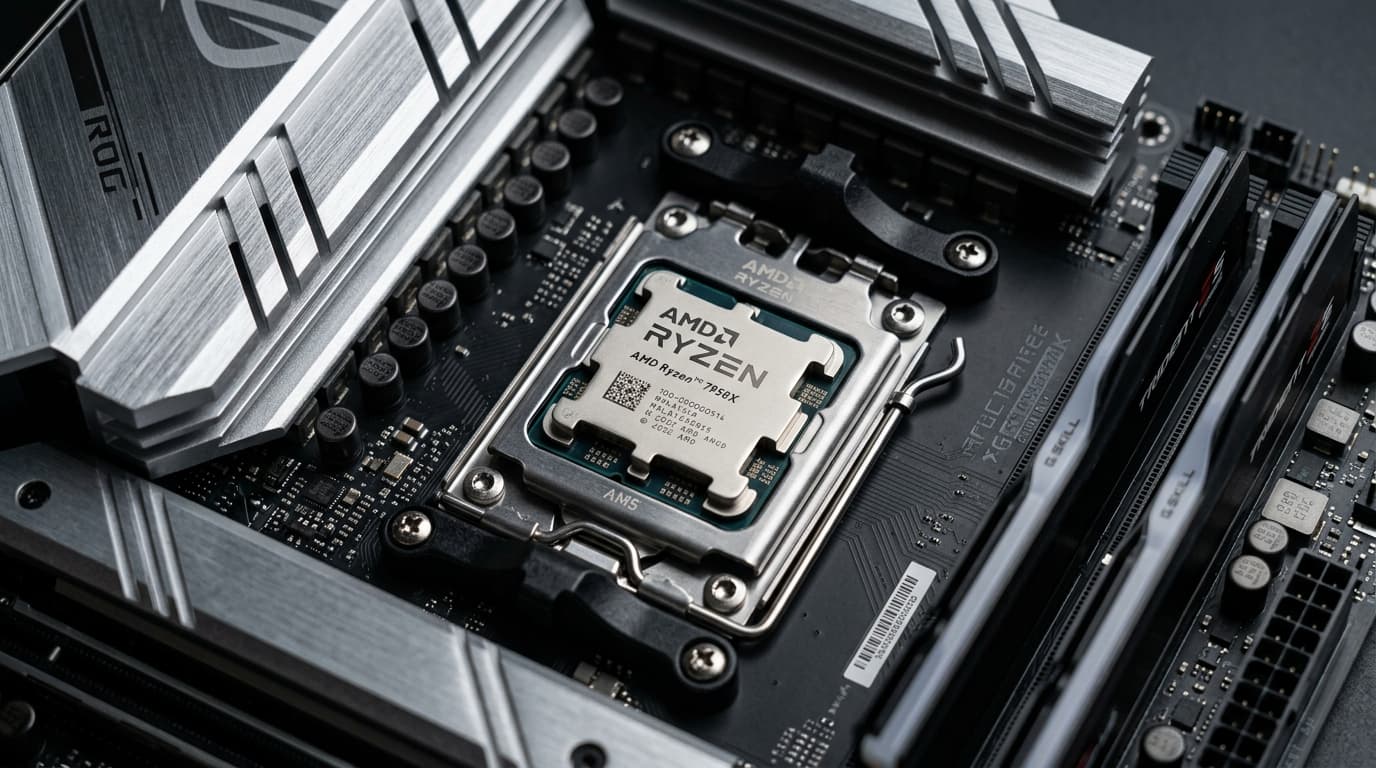
The Marketing Trap: "Bigger Megahertz Is Always Better"
When browsing DDR5 memory kits, it is easy to assume that 6400MHz or 7200MHz RAM must be faster than 6000MHz. If you are building an Intel platform, higher clock speeds can indeed scale well. But on AMD Ryzen 7000 and Ryzen 9000 (Zen 4 & Zen 5), the memory architecture works differently.
Here is the exact technical reality we explain on New Info Xplained, and why we configure our BFX builds the way we do.
The Heart of AM5: Infinity Fabric and UCLK:MCLK
On AMD AM5 processors, memory performance is determined not just by RAM clock speed, but by the relationship between:
- 1MCLK: Memory Clock
- 2UCLK: Memory Controller Clock
- 3FCLK: Infinity Fabric Clock
To achieve the lowest possible memory latency and best gaming frame times, the system must run in Coupled 1:1 Mode (where UCLK equals MCLK).
- At 6000 MT/s: The memory clock runs at 3000 MHz. Almost all AMD Ryzen memory controllers can easily sustain UCLK at 3000 MHz (1:1 ratio).
- At 6400 MT/s and above: Most AMD processors cannot sustain 3200 MHz on the memory controller without dropping to 1:2 Half-Speed Mode (where UCLK drops to 1600 MHz).
What happens when it drops to 1:2 Mode?
Memory latency instantly jumps by 8 to 12 nanoseconds. That increased latency hurts minimum 1% low frame rates in CPU-heavy games like Valorant, CS2, and Warzone.
Timing Tightness: Why CL30 Matters
Frequency is only half of the memory equation. CAS Latency (CL) dictates how many clock cycles the memory takes to respond to a data request.
- 6000MHz CL30 gives a true first-word response latency of 10.0 nanoseconds.
- 6000MHz CL40 has a much slower response latency of 13.3 nanoseconds.
In fast-paced esports games, that 3.3ns difference translates to smoother frame pacing, fewer micro-stutters, and more stable 1% low FPS.
Our Workshop Recommendation:
- 1For AMD Ryzen 7000 / 9000 (e.g. Ryzen 7 7800X3D, Ryzen 9 9900X): Stick with DDR5 6000MHz CL30 with verified AMD EXPO profile certification. Make sure it uses high-grade SK Hynix A-die or M-die chips for maximum sub-timing headroom.
- 2For Intel 14th Gen / Core Ultra: * Intel memory controllers can comfortably scale to 6400MHz – 7200MHz in Gear 2 without penalty, making faster kits worthwhile for synthetic rendering workloads.
How We Handle It at BFX:
Every custom BFX PC configured with DDR5 memory has its EXPO or XMP profile enabled and verified with secondary sub-timing tightening in BIOS before passing memory validation. You get maximum performance out of the box with zero manual headache.